Why supply duct leaks pull heat, humidity, and dust into your rooms and drive up peak‑hour AC bills.
Most homeowners in Louisiana blame their air conditioner, insulation, perhaps those loose, jiggling wood windows, or just the “old house” syndrome for hot rooms, muggy air, and dust that just won’t quit. Although all these can be contributing factors, one hidden problem in the attic is usually behind all of it at the same time: leaky supply ducts that turn your house into a vacuum and suck heat, humidity, and dust straight into your living space.
When those attic ducts leak, your AC doesn’t just waste the cooled air that escapes. The leaks depressurize your home, pull in hot, wet, dirty outside air through every crack, and keep your system running almost non‑stop during the most expensive peak‑rate hours of the day, exactly when power is costing you the most.
We detail, in plain language, why sealing your supply ducts is one of the highest‑ROI, lowest‑regret improvements you can make, often far more impactful than a new AC, UV lights, or a whole‑house dehumidifier.
What Is Supply Duct Leakage, Really?
When your air handler runs, it pushes cooled air into supply ducts that should deliver that air to your rooms. Every gap, loose boot, unsealed collar, or disconnected joint lets some of that air escape into your attic, crawlspace, or walls instead of your living space.
National research shows:
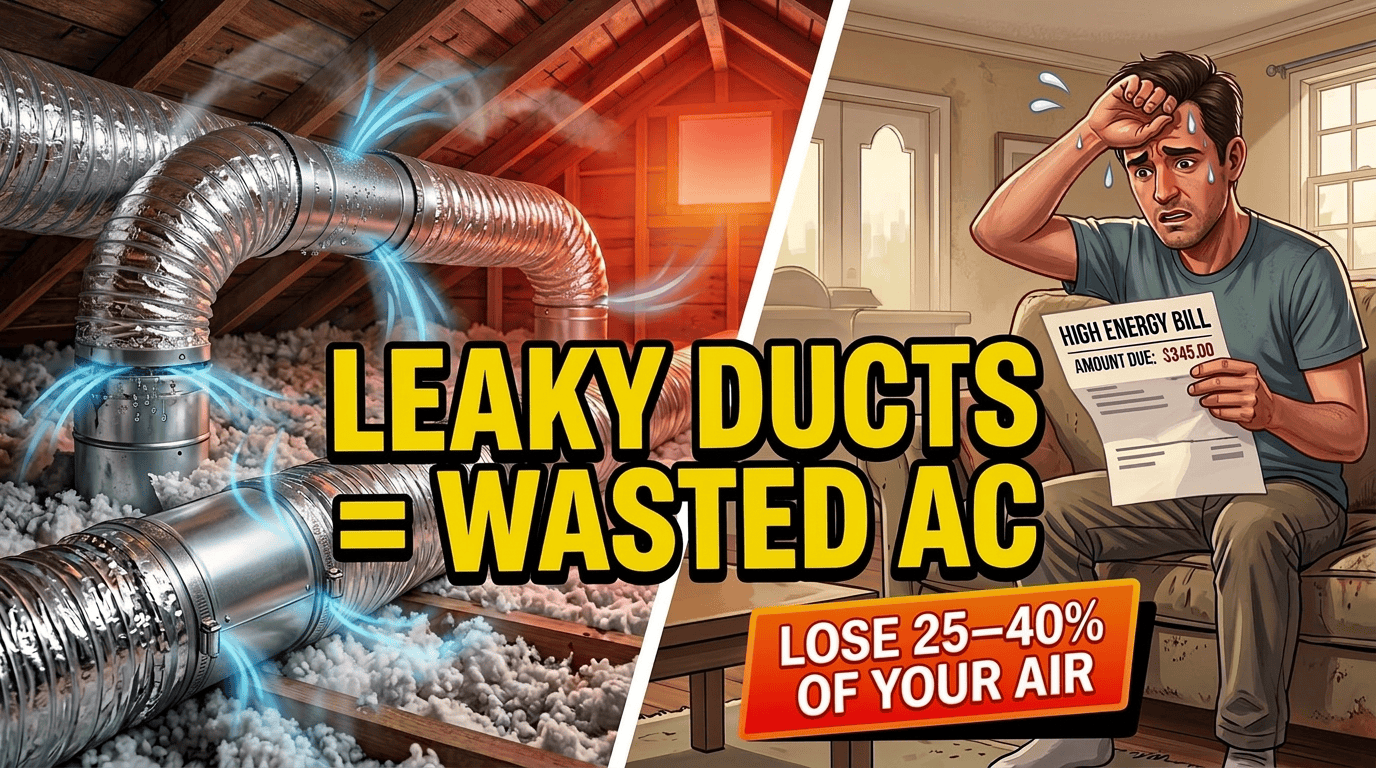
Typical homes lose 20–30% of conditioned air through duct leaks, poor connections, and holes.
Most leakage happens at registers, plenums, and branch connections, the exact areas that are almost never sealed during standard installs.
That alone is bad enough. But the big problem is what those leaks do to your house pressure.
The Invisible Vacuum: How Supply Leaks Depressurize Your Home
Your duct system is supposed to be balanced: as much air sent out through supplies as is pulled back through returns. When supply ducts leak to the outside (attic, crawlspace, garage), your system is still pulling a full volume of air from the house, but not all of it comes back.
Here’s what actually happens in a typical Louisiana home:
Consider a standard setup: a 1,800 square‑foot house with a 4‑ton AC unit. Each “ton” of cooling capacity is designed to move roughly 400 cubic feet per minute (CFM) of air – think of CFM the same way you’d think of gallons‑per‑minute for water, but with air instead of water. So, a 4‑ton system should push about 1,600 CFM through the ductwork into your living space.
Now imagine 25% duct leakage, which is common in homes with ducts in attics or crawlspaces:
400 CFM leaks out of the supply ducts into a 120–150°F attic instead of reaching your rooms.
The blower is still pulling the full 1,600 CFM from the house through the return-air grill.
Only 1,200 CFM actually make it back to the living space.
The missing 400 CFM is replaced by hot, humid outside air getting sucked in through cracks, attic bypasses, recessed lights, and wall gaps.
So you’re paying to cool both the air that leaked into the attic AND the extra 95-degree, high-humidity air that just got pulled into the house to replace it.
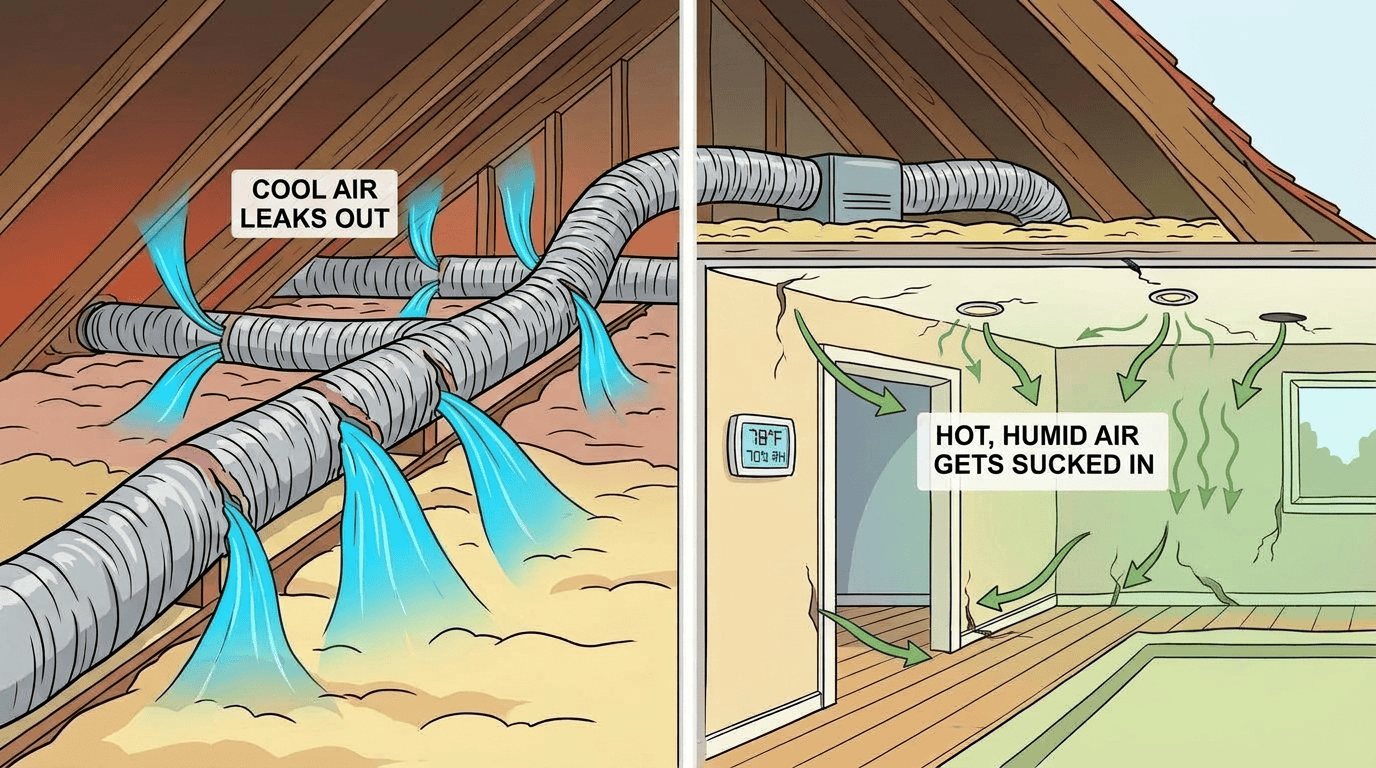
In building‑science terms, this is called depressurization and infiltration. Your house becomes a weak vacuum relative to the outside, and nature fills that void with whatever air it can grab.
The Runtime Reality: Non‑Stop AC During Peak‑Rate Hours
Here’s where this gets expensive in a very concrete way.
In a 1,800 ft² Louisiana home on a hot afternoon, 25% duct leakage is enough to keep a 4‑ton unit running almost continuously. It’s not fighting a static problem; it’s fighting a moving target: losing 400 CFM into the attic while dragging in more hot, wet air from outside to replace it.
Result: The system never shuts off during the hottest part of the day.
And that’s the killer: peak electricity rates in Louisiana typically run highest from 2 PM to 8 PM, exactly when your AC is fighting hardest against duct leakage and infiltration. A unit that should cycle on and off throughout the day instead runs nearly full‑time at the exact hour when utilities charge 30–50% more per kilowatt‑hour.
Studies confirm this pattern: homes with significant duct leakage show:
Infiltration rates 4 times higher than natural infiltration when the air handler operates.
System run times extended by 50% or more in real homes where leakage exists.
Significant additional energy loss specifically during peak afternoon and early‑evening hours.
That continuous runtime during peak rates is why a home with leaky ducts can feel like it’s bleeding money in the summertime.
Why This Is Brutal in Louisiana’s Hot‑Humid Climate
In a mild climate, duct leakage is expensive. In Louisiana, it’s brutal.
Key local realities:
Attics routinely hit 130–150°F in summer.
The Southeast “hot‑humid” region spends around 27% of total home energy on air conditioning, versus 12% nationally.
Some utilities in Gulf states estimate summer cooling can be up to 60% of the power bill.
Combine that with:
20–30% of your cooled air never reaching the rooms.
Infiltration rates spiking when the system runs because of depressurization.
Non‑stop runtime landing squarely in peak‑rate windows.
Now every CFM of leakage is effectively paid for three times:
You pay to cool air that never enters the living space.
You pay again to cool (and dehumidify) extra hot, wet outside air that’s sucked in to replace it.
You pay premium peak‑rate electricity for the privilege of doing both non‑stop.
This is why so many Louisiana homes feel clammy and uncomfortable even with “new” or “high‑efficiency” AC systems, and why bills stay high anyway.
Health Impacts: What You’re Breathing When Ducts Leak
When your house is under negative pressure, it doesn’t politely pull in fresh mountain air. It grabs whatever air is easiest to steal:
Super‑hot, dusty attic air
Damp crawlspace air loaded with soil gases
Garage air with car exhaust and stored chemical fumes
Air from wall and ceiling cavities full of old dust, pest droppings, and insulation fibers
Leaky ducts and the infiltration they drive are tightly connected to:
Mold and Moisture Problems
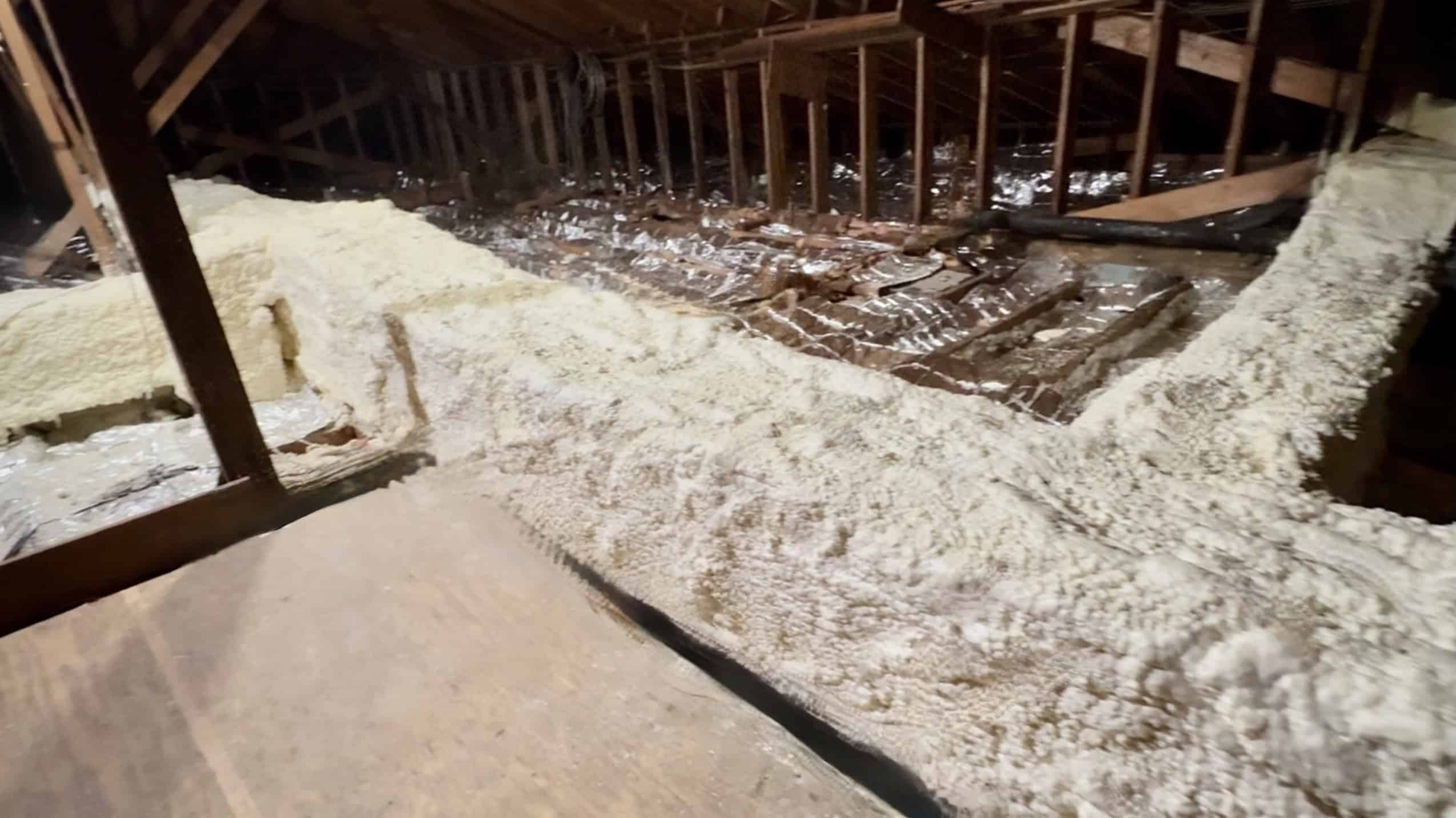
When cold supply air leaks into a 130°F attic, condensation forms on duct surfaces and nearby materials.
Moisture + organic materials (wood, dust, paper facing) = ideal conditions for mold growth in attics and within duct insulation.
Spores are then drawn into the house and circulated whenever the system runs, worsening allergies, asthma, and respiratory issues.
Dust, Allergens, and Indoor Air Quality
HVAC industry sources estimate that unsealed ductwork commonly pulls dust, pollen, and insulation fibers into the duct system, then distributes them throughout the home.
Dirty ducts and continuous infiltration act as a “reservoir” of allergens, recirculating particles every time the blower runs.
For families with kids, older adults, or anyone with asthma or allergies, this is not just a nuisance, it’s a serious health issue.
Combustion Safety and Backdrafting
Negative pressure from duct leaks also affects gas appliances.
Research on house depressurization shows:
When exhaust fans and air handlers depressurize the home, they can reverse the draft in chimneys and vents, a phenomenon called backdrafting.
Backdrafting pulls combustion gases (including carbon monoxide and nitrogen dioxide) into the living space instead of sending them outdoors.
If you have a naturally vented gas water heater, furnace, or fireplace, uncontrolled depressurization from duct leakage is a direct safety risk, not just an efficiency problem.
Comfort: Why You Have Hot and Cold Rooms and Muggy Air
Homeowners often describe:
One or two rooms that are always too hot or too cold
Long AC run times with little improvement
A sticky, humid feeling even when the thermostat says 72–75°F
Leaky supply ducts are involved in all three.
Uneven Temperatures and Hot/Cold Spots
When supply ducts leak, especially in long runs to remote rooms:
Cooled air dumps into attics or crawlspaces instead of the target room.
The “end of the line” rooms never get their share of air, creating persistent hot or cold spots.
The thermostat may be near the center of the home, where temperatures look fine. But bedrooms, bonus rooms, or additions stay uncomfortable, no matter how low you set the thermostat.
High Humidity and “Clammy” Feeling
Depressurization pulls in:
Hot, humid outdoor air
Moist air from crawlspaces or vented attics
At the same time, duct leakage:
Reduces delivered airflow where it’s needed
Keeps the system running for hours without a break, disrupting dehumidification cycles that need pauses to work properly
The result is a house that never quite dries out, even if the temperature number looks okay. In hot‑humid climates, building‑science experts consistently rank duct leakage and uncontrolled ventilation as primary drivers of chronic indoor humidity problems.
Energy and Money: What Duct Sealing Can Actually Save
Energy programs and field research give some solid numbers for what proper duct sealing delivers:
Duct sealing typically reduces leakage flows by about 40–70% in real homes.
That translates into 10–30% reductions in HVAC energy use in many studies.
Several utility and industry sources estimate whole‑house energy savings of 10–20% when duct sealing is part of an air‑sealing package.
In dollar terms:
Typical homeowners see $200–$400 per year in bill reduction from duct sealing alone, depending on climate and pre‑existing leakage.
Some analyses report $300–$700 per year in savings for leakier homes or high‑cost regions.
In peak‑rate regions, the savings can be even higher because fewer non‑stop runtime hours during 2–8 PM = avoiding high‑rate electricity charges.
When you compare that to the cost of work:
Manual duct sealing for an average home often runs $1,000–$2,500, with broader ranges of $500–$4,000 depending on size and complexity.
Payback periods typically fall in the 2–5 year range, with some case studies showing payback just over two years.
With help from local utility company incentive programs, there may even be no out-of-pocket cost, resulting in an immediate infinite return.
And that’s before counting:
Longer equipment life (because the system finally operates within design conditions)
Avoided costs for unnecessary “solutions” like upsized AC units, whole‑house dehumidifiers, or UV systems
Reduced risk of moisture damage and mold remediation
The “Ignorance Tax”: Why Homeowners Get Sold the Wrong Fix
When a house has dust, humidity, comfort issues, and high bills, most contractors look at symptoms, not root causes.
Common recommendations:
Bigger or “more efficient” AC system: $10,000–$24,000+.
Whole‑house dehumidifier: $2,000–$4,500 installed.
UV light system for coils/ducts: $400–$1,500 installed.
Premium filters and add‑on air cleaners: hundreds more per year.
Yet if the supply ducts are leaking 20–30% into a 140°F attic, and the home is under constant negative pressure, none of these products fix the real problem. At best, they partially mask symptoms while the underlying physics keeps fighting you. Do you really believe your HVAC contractor wants to visit your home at no cost if it doesn’t result in a sale?
This mismatch between what’s sold and what’s needed is what many in the building‑science world call the “ignorance tax.” Homeowners pay it when they don’t know enough to ask about duct leakage, pressure balance, and infiltration, and when their “expert” doesn’t either.
By contrast, duct sealing:
Directly addresses the cause of wasted energy and poor comfort
Is significantly cheaper than full system replacement
Often qualifies for utility incentives that cut the out‑of‑pocket cost and shorten payback even further (many utilities specifically incentivize duct sealing because it reliably reduces peak loads and overall consumption).
What Proper Duct Sealing Looks Like
Not all sealing jobs are equal. For real, durable results, a contractor should:
Test and diagnose the system
Use a duct leakage test (duct blaster or equivalent) to quantify total leakage and leakage to outside at a reference pressure, often 25 Pa.
Identify pressure imbalances and how much of the leakage is on the supply versus the return side.
Seal the right places
All joints at supply plenums, takeoffs, and trunk‑to‑branch connection
Collars and boots where ducts meet registers and grilles
Flex‑duct inner liners to metal collars, secured with mastic plus mechanical fastening (not just tape)
Boot‑to‑drywall gaps at ceilings, walls, and floors are very common and very often ignored leaks that connect directly to attics and wall cavities.
Use durable materials
Water‑based UL-approved mastic products as the primary sealants on accessible joints and seams; building‑America research in hot‑humid climates has shown mastic to be far more durable and effective than tape.
Aerosol sealing for internal leaks if the duct system is inaccessible.
Verify improvement
Re‑test after sealing to confirm and quantify the reduction of air leakage.
When done at this level, duct sealing is not a band‑aid; it’s a long‑term correction to how your home moves air and moisture.
Why Supply‑Side Sealing Is Priority #1
Both supply and return leaks matter, and each has its own pathologies. But when triaging problems in a typical Gulf‑Coast home, supply leakage deserves special focus because it:
Directly dumps cooled air into the harshest environments (attics, garages, crawlspaces).
Creates whole‑house negative pressure, which multiplies infiltration and drags in contaminants.
Makes every other comfort and IAQ problem worse, from mold to CO hazards.
Drives non‑stop runtime during peak‑rate hours, creating the highest‑cost electricity losses.
Return leaks are also critical (especially when they pull in attic, garage, or crawlspace air), but as a first‑line strategy for energy, health, and comfort, supply‑side duct sealing is often the lowest‑hanging fruit with the fastest payback.
How to Know If Duct Sealing Should Be Your First Move
You don’t need to be a building scientist to suspect duct problems. Strong clues include:
High summer bills despite “decent” equipment and insulation
One or more rooms that never reach the setpoint
Visible gaps around ceiling or floor registers
Ducts and boots in the attic with no mastic on seams or collars
Dust streaks or discoloration around supply grilles
Musty smells that intensify when the AC runs
Gas water heater or furnace in a closet, attic, or garage combined with other pressure‑creating equipment (exhaust fans, dryers, etc.)
If any of these appear familiar, a properly performed duct leakage test and sealing job is usually a smarter first investment than spending thousands to tens of thousands in treating the symptoms versus permanently addressing the cause.
The Takeaway for Homeowners
For homes in hot‑humid climates like Louisiana, unsealed supply ducts are often the #1 hidden cause of:
High energy bills and non‑stop peak‑rate consumption
Hot/cold spots and all‑day AC run times
Persistent humidity and mold issues
Dust and poor indoor air quality
Combustion safety risks
National labs, utilities, and building‑science researchers have all identified duct sealing, especially in homes with ducts in attics or crawlspaces, as one of the most cost‑effective efficiency upgrades available.
Instead of paying the “ignorance tax” on oversized systems, dehumidifiers, and gadgets that treat the symptoms, start with the physics: seal the duct system, stop the depressurization, and cut off the uncontrolled infiltration at its source.
Only once your ductwork is tight and your house is pressure‑balanced, everything else you do – insulation, equipment upgrades, filtration, cool shiny gadgets – works better and costs less for years to come. If you want to dig deeper into the building‑science behind this, these research papers and articles are a great place to start.
FAQ: Leaky Ducts in New Orleans Homes
Common signs are hot or cold rooms, dusty supply vents, musty smells when the AC runs, and summer bills that seem too high for your home size and equipment. You may also see gaps or unsealed joints around ceiling registers and metal boots in the attic. If you’re seeing a few of these in your home, it’s worth having Diversified Energy perform a duct and pressure check so you know exactly what’s going on.
Our attics routinely hit 130–150°F in summer, and the outside air is hot and very humid. When supply ducts leak into that attic, your AC has to cool both the air that escaped and the extra hot, wet air that gets sucked into the house to replace it. That’s why we treat duct sealing as a core Home Performance solution in South Louisiana, not an optional add‑on.
Yes. When supply ducts leak to the attic or crawlspace, the system still pulls full airflow from the house but doesn’t send it all back. That negative pressure literally pulls outside air in through every crack, recessed light, and wall gap, like a weak, whole‑house vacuum. Our testing equipment lets us measure that pressure and show you, in real numbers, how much your home is being “sucked on.”
Field studies show proper duct sealing can cut HVAC energy use by 10–30% and whole‑house energy by 10–20% in many homes. In hot‑humid climates with high AC run time, it’s often one of the fastest‑payback improvements you can make. When we evaluate a home, we’ll walk you through realistic savings ranges for your house before any work starts.
In many cases, yes, at least as a first step. If ducts are leaking 20–30% into a 140°F attic, a new high‑efficiency unit or dehumidifier won’t fix the root problem. Tightening the ducts first lets your existing equipment really do its job. At Diversified Energy, we look at the whole home and recommend a sequence—duct sealing, air sealing, equipment upgrades, so you’re not paying for band‑aids.
A good contractor will test the duct system, seal plenums, collars, boots, and joints with mastic (and mechanical fasteners on flex connections), address boot‑to‑drywall gaps, and then retest to confirm the leakage reduction. In some homes, internal aerosol sealing is used for hard‑to‑reach duct runs. Our crews follow this building‑science approach on every project so you’re getting a durable, measurable improvement, not just tape over a few leaks.
Many utilities in hot‑humid regions offer incentives or rebates for duct sealing and related Home Performance work because it reliably cuts peak cooling loads. To find out what’s available for your home, call Diversified Energy at 504‑273‑7779 and we’ll answer your questions, check current programs, and get you scheduled, turnkey, start to finish.
References
Cooling energy use in hot, humid climates – Florida Solar Energy Center report on duct leakage and AC performance in the Southeast.
Duct Sealing: A Key to Energy Savings – U.S. Department of Energy, Building America guidance on duct sealing methods and benefits.
Duct Leakage Basics – The Energy Conservatory overview of how duct leakage is measured, why it matters, and typical leakage levels.
How Duct Leakage Steals Twice – Green Building Advisor article explaining why supply leaks waste energy and increase infiltration at the same time.
Energy implications of air leakage in ducts – Air Infiltration and Ventilation Centre (AIVC) paper summarizing research on duct leakage and building performance.
4 Ways a Bad Duct System Can Lead to Poor Indoor Air Quality – Energy Vanguard article on duct leakage, dust, and IAQ.
How Does HVAC Ductwork Affect Indoor Air Quality? – American Standard overview of duct design, leakage, and impacts on comfort and IAQ.
Moisture and Ventilation Solutions in Hot‑Humid Climates – U.S. Department of Energy article with guidance on moisture control and ventilation in climates like Louisiana.
Energy Effectiveness of Duct Sealing and Other Measures – Lawrence Berkeley National Laboratory report on savings from duct sealing and related upgrades.
Impacts of Duct Sealing on Peak Demand and Energy Use – ACEEE conference paper summarizing field data on duct sealing, energy savings, and peak load reduction.