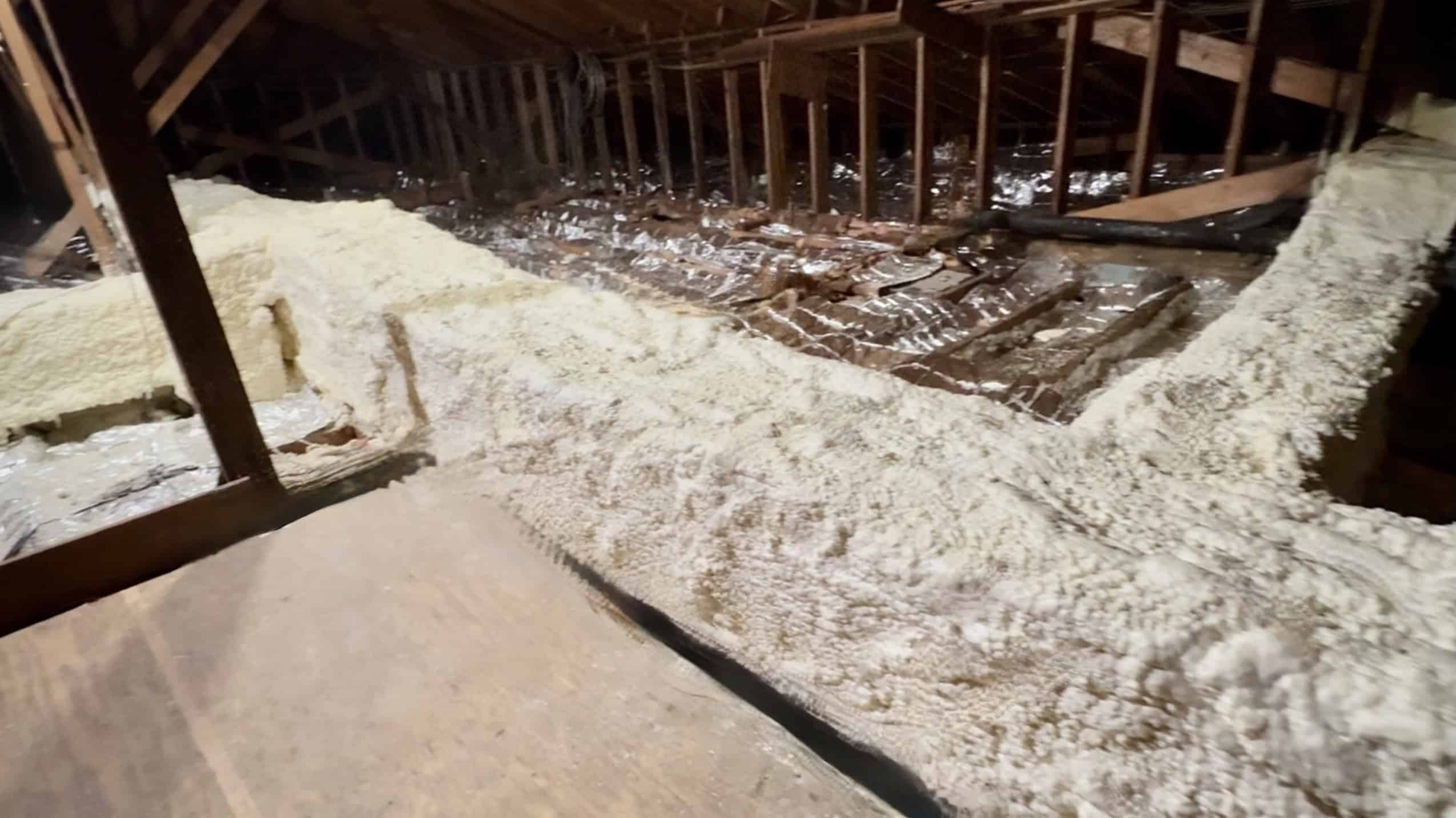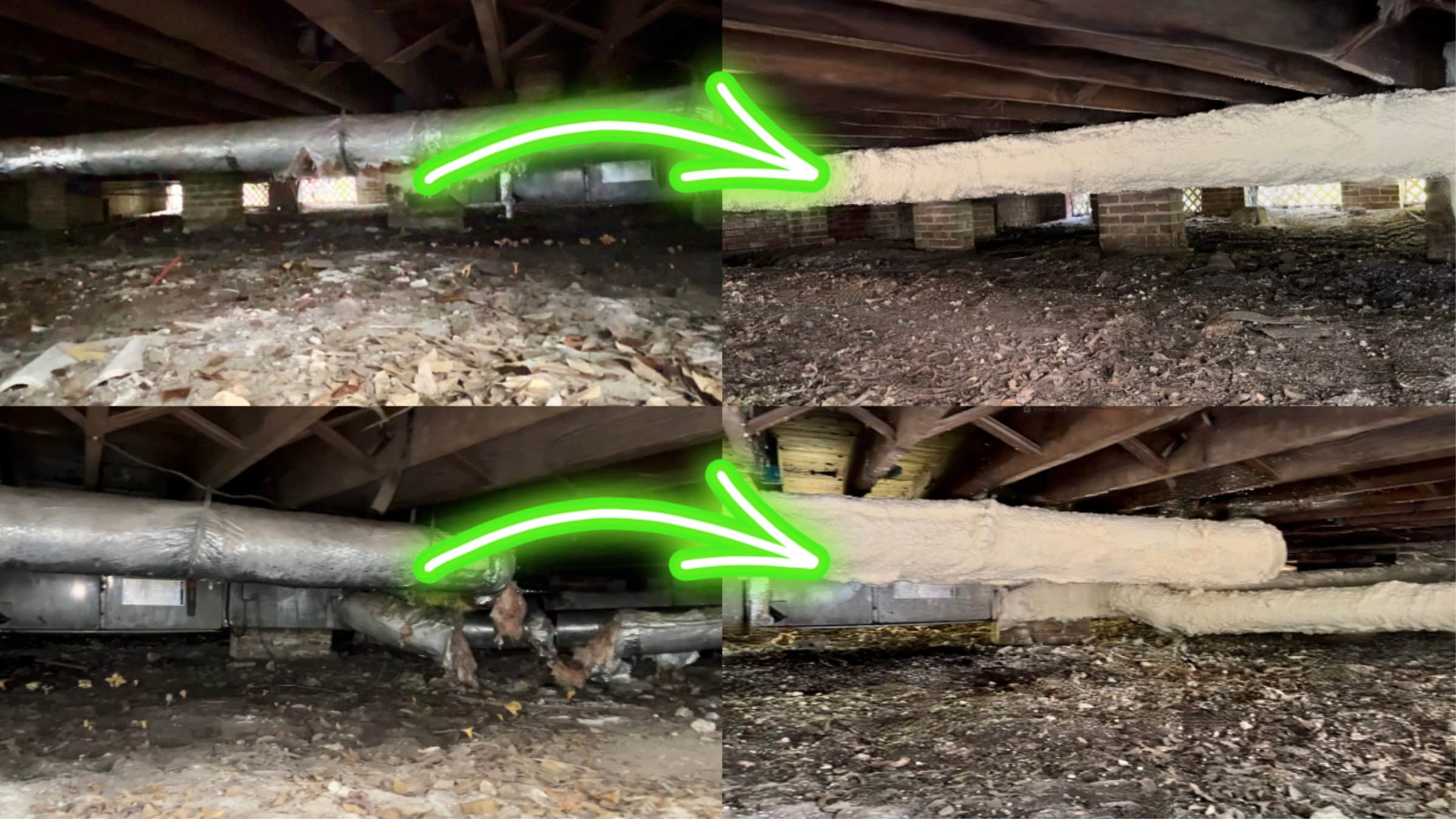
Your Crawlspace is a Humidity Nightmare – And Fiberglass is Making It Worse
Here’s the brutal truth: Your New Orleans crawlspace is like a steam bath, with humidity levels hitting 70-80% year-round. That fiberglass wrapped around your metal ducts? It’s absorbing moisture like a sponge and losing up to 50% of its insulating power.
You’re essentially paying to cool wet insulation that’s about as effective as wrapping your ducts in soggy newspaper. Meanwhile, that failing fiberglass is creating the perfect breeding ground for mold, rust, and decay that’s slowly destroying your home’s foundation.
According to the U.S. Department of Energy’s Building America program, moisture-compromised ductwork in humid climates can increase cooling costs by 15-25% and dramatically reduce indoor air quality.
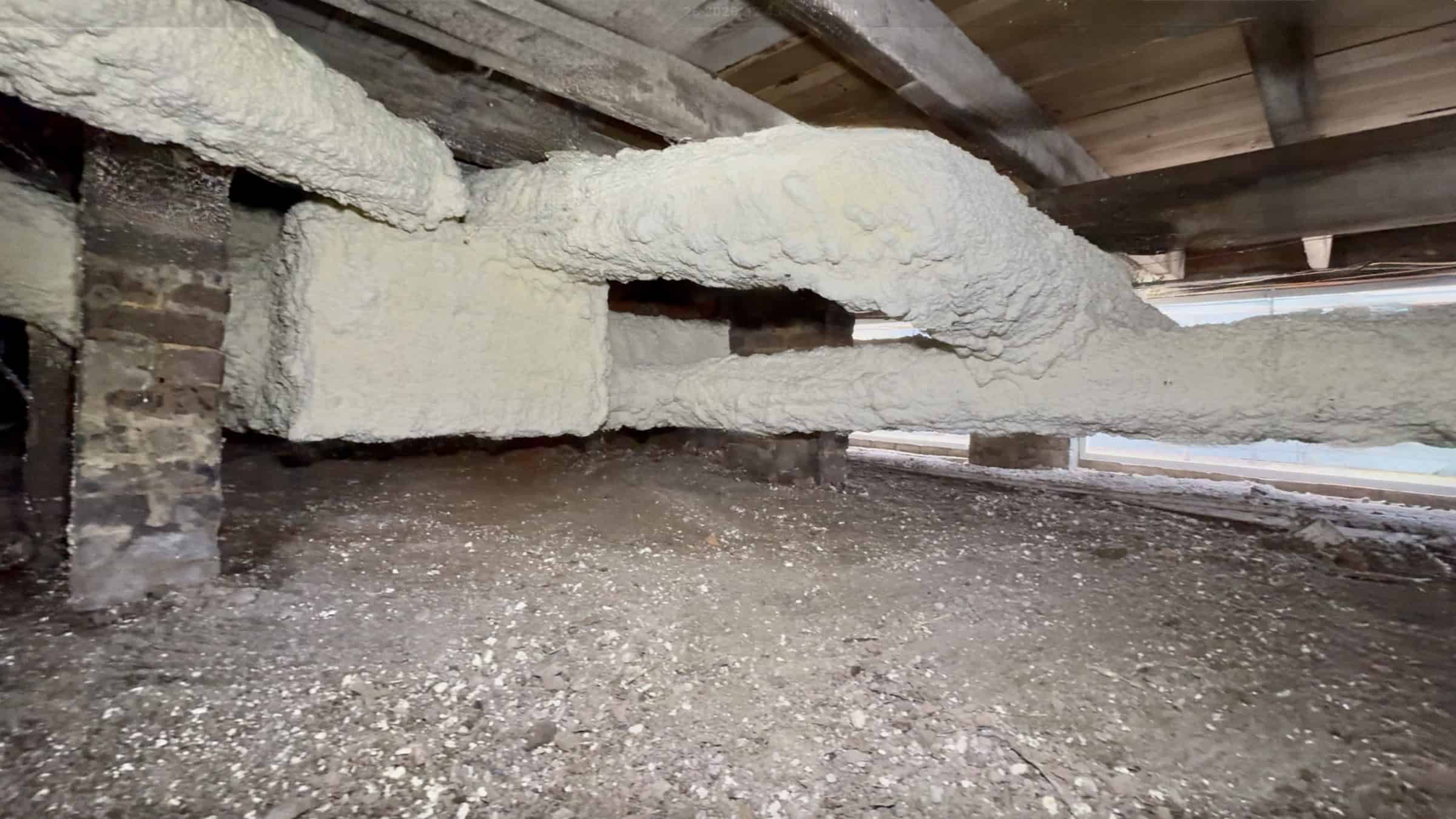
Get Your Ductwork Insulated With Spray Foam
The Moisture Disaster Happening Right Under Your Feet
Every day, New Orleans’ 80-90% humidity is attacking your ductwork from below. That high water table—sometimes just 2-3 feet underground – is pushing moisture vapor up through your crawlspace like a relentless steam engine.
Your fiberglass is literally falling apart. It’s sagging, molding, and creating gaps that let humid air attack your cool ductwork directly. The result? Sweating ducts, skyrocketing energy bills, and that musty smell creeping into your living space.
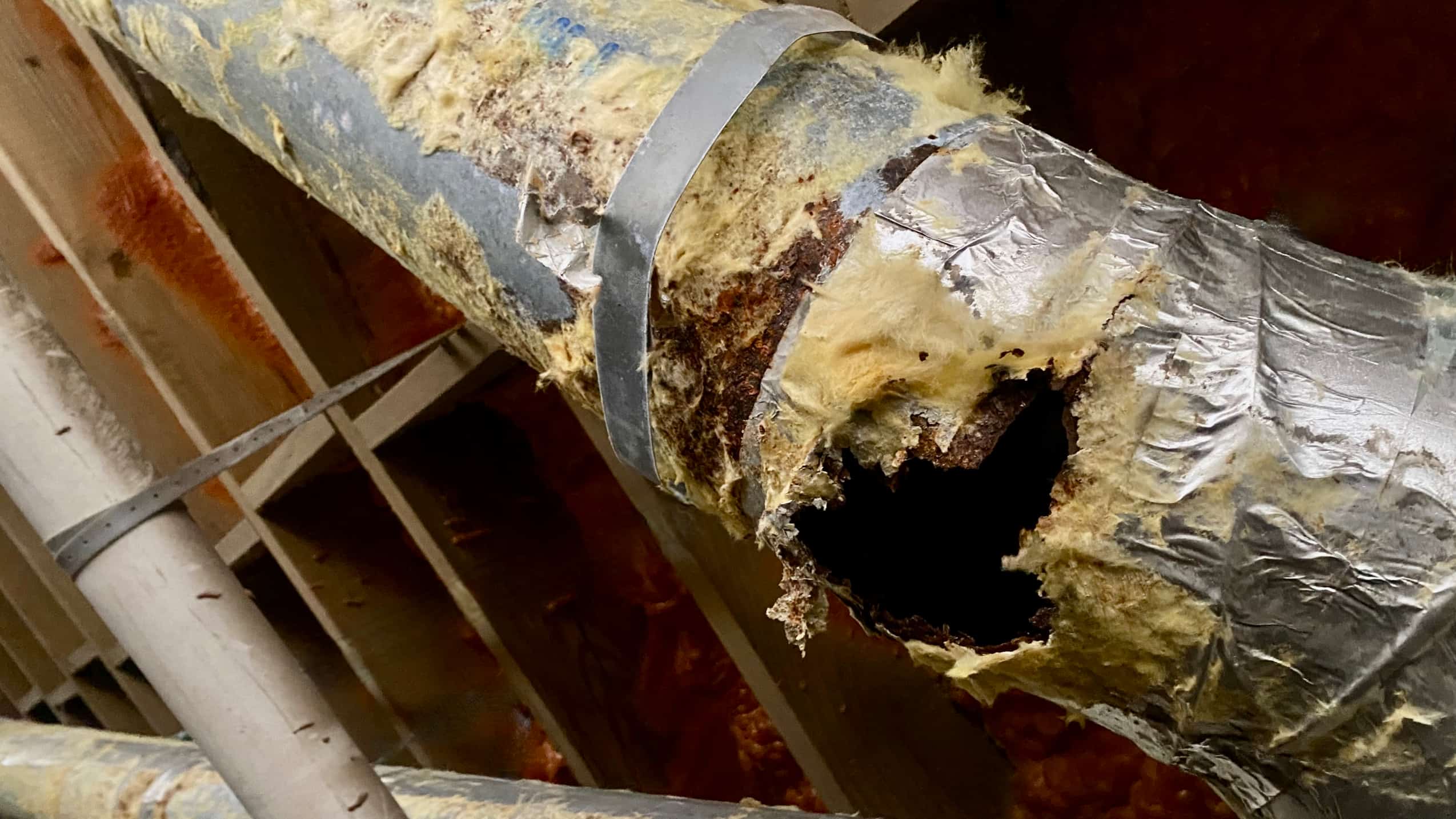
What Crawlspace Condensation Does To The Ductwork
When 55°F conditioned air flows through metal ducts surrounded by 85°F, 75% relative humidity crawlspace air, poorly insulated duct surfaces drop below the dew point. This causes:
Premature failure of the duct adhesives and insulation
Rust and corrosion on metal ductwork and fasteners
Mold growth on ducts, joists, and subfloors
That musty smell circulating through your home via return air leaks
Wood rot and structural damage over time
Fiberglass duct wrap around rigid metal ducts in a humid crawlspace depends on perfect air‑tight installation to keep the insulation dry. Field studies and contractor reports show that in real crawlspaces, even the most insignificant gaps and deterioration allow humid air to enter the insulation causing condensation to occur on the metal surface, leading to moisture‑loaded fiberglass that can lose on the order of 10–40% of its effective R‑value and, when saturated, becomes essentially non‑insulating.
The Closed-Cell Foam Solution: Your Moisture-Fighting Superhero
Here’s what happens when Diversified Energy strips away that failing fiberglass and encapsulates your ductwork with closed-cell spray foam:
Bulletproof Moisture Barrier
Our closed‑cell foam has a tested permeance below 1 perm at the installed thickness, so it qualifies as a Class II vapor diffusion retarder under current building code definitions.
The International Residential Code (IRC) Section M1601.4.1 gives spray polyurethane foam a special exemption: it’s the only duct insulation that doesn’t require additional air sealing at joints and seams, because the foam itself provides superior air and moisture control.
No More Condensation Disasters
That cool air flowing through your ducts won’t sweat anymore. Closed-cell foam keeps duct surfaces above dew point even when your crawlspace hits 90%+ humidity. No more dripping, no more mold, no more rust eating away at your valuable metal ductwork.
True R-Value Performance
While soggy fiberglass delivers maybe R-2 in real-world conditions, closed-cell foam maintains its full R-6.5 to R-7.0 per inch regardless of moisture exposure. That’s triple the performance of what you have now!
FEMA Class 5 Flood Resistance
According to FEMA Technical Bulletin 2, closed-cell spray foam receives the highest flood-resistance rating (Class 5), meaning it can withstand direct contact with floodwater for 72+ hours and be successfully cleaned and reused.
Fiberglass, by contrast, receives only a Class 2 rating; it must be completely removed and replaced after any flood exposure.
What Your Crawlspace Problems Are Really Costing You
Every month that failing fiberglass stays down there, you’re losing money:
$50-300+ monthly in wasted energy from moisture-compromised insulation (depending on system size and number of units)
Constant mold remediation costs from chronic moisture problems
Structural damage from rusted ductwork and rotting floor joists
Indoor air quality issues from musty crawlspace air entering your home through leaky returns or supply duct leaks that depressurize your living space
The One-Time Investment That Ends the Cycle
Closed-cell foam ductwork encapsulation is literally a lifetime solution. While you’d need to replace that failing fiberglass every 5-10 years in New Orleans’ harsh crawlspace conditions, closed-cell foam lasts 50+ years with zero maintenance.
Do the math: Stop the endless cycle of replacement and upgrade once to the ultimate solution.
ASHRAE research (American Society of Heating, Refrigerating and Air-Conditioning Engineers) shows that properly sealed and insulated ductwork can reduce energy bills by 20-30% in humid climates like ours. That’s $600-1,800 in annual savings for typical New Orleans homes.
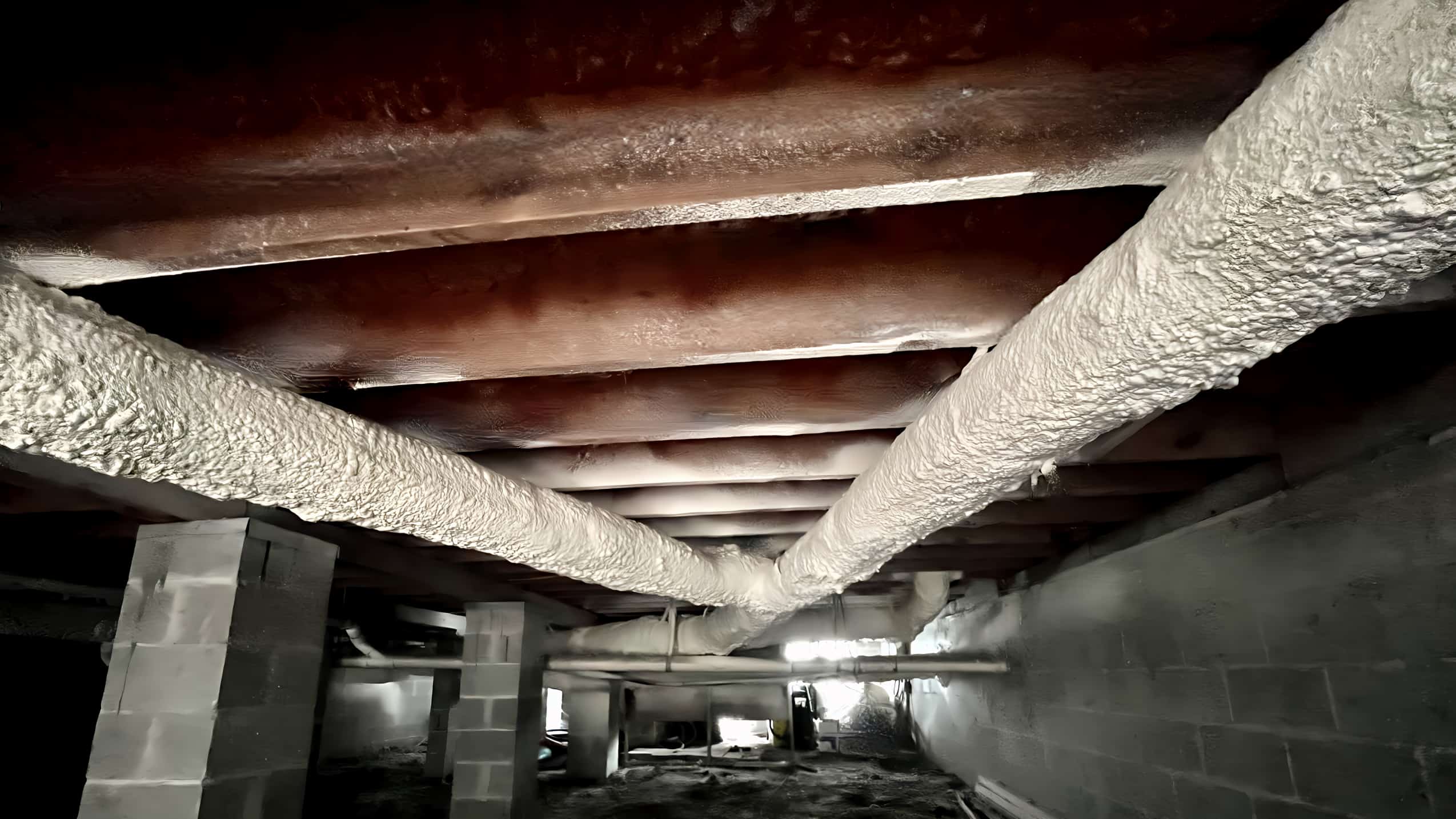
Your Crawlspace Deserves Better Than Another Fiberglass Failure
Why would you replace failing fiberglass with more fiberglass? That’s like fixing a leaky roof with another leaky roof! Your quality metal ductwork deserves insulation that can handle New Orleans’ extreme moisture conditions.
Storm surge, flooding, hurricanes – closed-cell foam survives it all. While fiberglass becomes a soggy, moldy mess that needs complete replacement after every weather event, closed-cell foam cleans up and keeps performing.
University of Florida engineering research documented that homes with closed-cell spray foam insulation experienced 60-70% less flood damage during Hurricane Harvey and returned to habitability 3-4 weeks sooner than conventionally insulated homes.
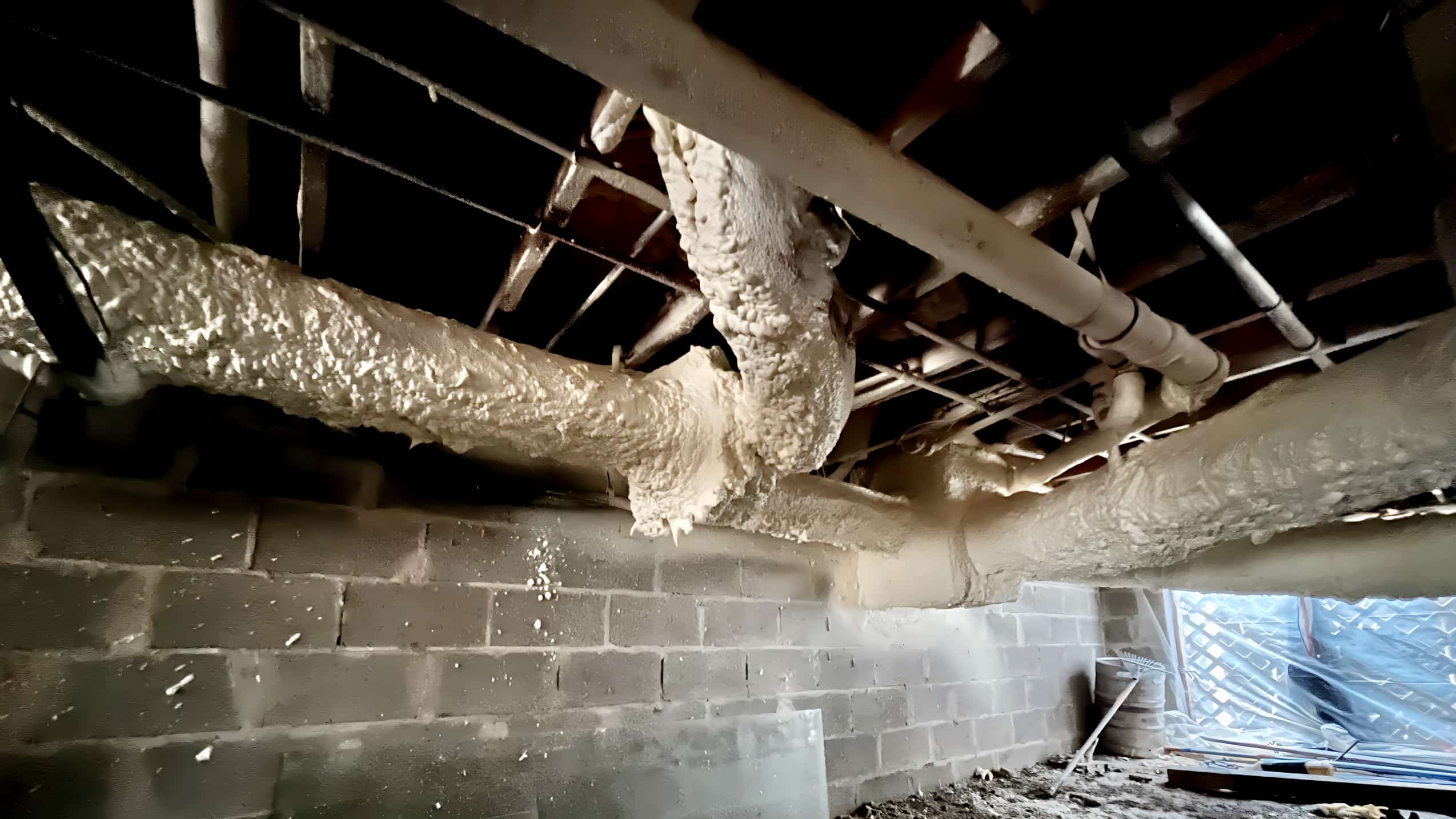
Protection Against New Orleans’ Unique Crawlspace Challenges
High water table pressure? No problem.
Salt air corrosion? Blocked completely.
Pest intrusion? They can’t penetrate it.
Flood recovery? Just rinse and continue.
Closed-cell foam handles everything New Orleans can throw at it while maintaining peak thermal performance year after year.
Unlike fiberglass wrap, spray foam ductwork doesn’t interfere with access to plumbing, electrical, or HVAC equipment in your crawlspace. If repairs are needed, contractors can cut through the foam at specific locations, make repairs, and reapply foam seamlessly, typically for $50-150 per location.
Why Building Science Matters
The recommendations you’ll find in this FAQ aren’t based on marketing hype, they’re backed by decades of research from organizations like FEMA, the Department of Energy, Oak Ridge National Laboratory, the University of Florida, and professional engineering societies like ASHRAE.
Building science teaches us that the best solutions are the ones that work with physics, not against it. Closed-cell spray foam succeeds because it addresses the fundamental problems of air leakage, moisture control, and thermal performance in a way that conventional materials simply can’t match.
For Louisiana homeowners dealing with humid crawlspaces, heat, and the ever-present threat of severe weather, spray foam ductwork encapsulation represents the smart choice, proven by research, endorsed by experts, and validated by real-world performance in the toughest conditions imaginable.
Ready to Upgrade Your Crawlspace Ductwork?
Contact Diversified Energy to learn more about closed-cell spray foam ductwork encapsulation for your crawlspace. We’re New Orleans’ building science experts, and we’ll help you create a more efficient, comfortable, and resilient home.
Frequently Asked Questions
Closed-cell spray foam creates a seamless, airtight seal that fiberglass wrap simply cannot match. Here’s why that matters:
When spray foam is applied to your ductwork, it bonds directly to the metal surface and expands to fill every gap, crack, and irregular shape. This creates a complete thermal and air barrier in one step. Fiberglass wrap, on the other hand, is held in place with straps and ties, leaving gaps where air and moisture can sneak through.
The 2021 International Residential Code recognizes this advantage; spray foam is the only duct insulation that doesn’t require additional air sealing at joints and seams. That’s a testament to how effective it is at stopping air leaks right out of the gate.
Building Science Insight:
According to the U.S. Department of Energy’s Building America program, traditional duct systems lose 15-30% of conditioned air through leaks. Spray foam encapsulation reduces that to less than 5%, which means more cool air actually reaches your living space.
No, and here’s why this is actually one of spray foam’s biggest advantages.
Unlike fiberglass or other insulation materials that just sit on top of your ducts, closed-cell spray foam chemically bonds to the metal surface. There’s no air gap or space for moisture to accumulate. Think of it like a waterproof coating that becomes part of the duct itself.
Fiberglass, by contrast, is held away from the duct by straps and fasteners. Air can circulate in these gaps, carrying moisture that condenses on cold duct surfaces, leading to rust, mold, and that musty smell many Louisiana homeowners know all too well.
Research Findings:
Oak Ridge National Laboratory (a U.S. Department of Energy research facility) found that closed-cell spray foam maintains its insulating performance even in humid conditions, while fiberglass can lose 30-50% of its effectiveness when it gets damp.
Closed-cell spray foam should last 50+ years with zero maintenance. Fiberglass wrap typically needs replacement in 7-12 years, especially in humid crawlspace environments like we have in Louisiana.
Why Fiberglass Breaks Down:
Moisture from humid air degrades the binders holding the fibers together
Gravity causes sagging and compression over time
Rodents and insects disturb it, creating gaps
Straps and fasteners loosen, allowing the insulation to slip
Why Spray Foam Lasts:
It’s bonded to the duct – it can’t sag or slip
The closed-cell structure doesn’t absorb moisture
Rodents and insects can’t nest in it
It’s chemically stable and won’t break down over time
Post-Hurricane Evidence:
After Hurricane Katrina, FEMA’s assessment teams found that spray foam installations remained intact and functional even after being submerged in floodwater for weeks. Fiberglass insulation had to be completely removed and replaced in every case.
Yes, and it’s one of the highest-rated materials you can use.
FEMA (Federal Emergency Management Agency) rates building materials on a 5-class scale for flood resistance. Closed-cell spray foam receives a Class 5 rating, the highest possible. This means it can withstand direct contact with floodwater (including moving water) for 72+ hours and be successfully cleaned and reused.
Fiberglass insulation receives a Class 2 rating, which means it’s considered unacceptable for flood-prone areas. After any flood exposure, it must be removed and replaced because it cannot be cleaned of contaminants.
What This Means for Louisiana Homeowners:
If you live in a flood zone or have ever dealt with water in your crawlspace, spray foam gives you peace of mind. After a flood event, you can pressure-wash and sanitize the foam, no need to tear out and replace insulation, saving you thousands of dollars and weeks of reconstruction time.
FEMA’s Official Statement:
According to FEMA Technical Bulletin 2, “Sprayed polyurethane foam is highly resistant to floodwater damage, including damage caused by moving water. These materials can survive wetting and drying and may be successfully cleaned after a flood.”
Yes. Closed-cell spray foam actually reinforces your ductwork and increases its structural strength.
When spray foam is applied at the recommended thickness (1.5-2 inches), it creates what engineers call a “composite structural assembly.” The foam bonds to the metal and distributes stress evenly across the entire surface, preventing dents, collapse, and deformation, especially in flexible duct sections.
University of Florida Research:
Studies conducted by the University of Florida’s Engineering School found that spray foam increases the structural rigidity of building assemblies by 200-300%. In hurricane testing, homes with spray foam insulation showed dramatically better resistance to wind damage and structural failure.
This same principle applies to ductwork: the foam helps your ducts maintain their shape and integrity, even under the negative pressure created by your HVAC system.
Absolutely. Most homeowners see a 10-15% improvement in cooling efficiency, which translates to lower energy bills and a more comfortable home.
Here’s what spray foam does for your HVAC system
Stops Air Leaks:
The Department of Energy estimates that 20-30% of conditioned air is lost through leaky ducts in a typical home. Spray foam seals those leaks, so more cool air actually reaches your rooms.
Better Insulation:
Spray foam bonds directly to the duct with no air gaps, so it performs better than fiberglass even at the same thickness. In Gulf Coast crawlspaces (where temperatures often hit 85°F with 75-80% humidity), this makes a huge difference.
Prevents Condensation:
When cold air flows through ducts in a hot, humid crawlspace, condensation forms on poorly insulated surfaces. This wastes energy, rusts your ductwork, and can lead to mold. Spray foam provides enough insulation to keep duct surfaces above the dew point, eliminating condensation completely.
Real-World Results:
ASHRAE (American Society of Heating, Refrigerating and Air-Conditioning Engineers) research shows that reducing duct leakage from 20% to 5% improves system efficiency by 10-12%. In Louisiana’s climate, homeowners typically see cooling cost reductions of 15-25%.
Exceptionally well. In fact, it’s one of the reasons FEMA now recommends it for coastal and hurricane-prone areas.
Hurricane Katrina (2005):
FEMA’s post-storm assessment teams found that homes insulated with closed-cell spray foam survived significantly better than conventionally built homes. The foam remained bonded to walls and roofs even after weeks of flooding, and the buildings returned to habitability much faster.
Hurricane Harvey (2017):
Engineering assessments in the Houston area found that homes with spray foam experienced 60-70% less flood damage and were ready for occupancy 3-4 weeks sooner than homes with traditional insulation.
Hurricane Michael (2018):
In Mexico Beach, Florida, which took a direct hit from a near-Category-5 storm with 160 mph winds, homes with spray foam-insulated roofs had dramatically higher survival rates. Engineers attributed this to the foam creating a stronger bond between the roof sheathing and the structure.
What This Means:
Spray foam doesn’t just insulate, it strengthens your home’s ability to withstand extreme weather, high winds, and flooding. For Gulf Coast homeowners, that added resilience is invaluable.
Yes. Once it’s fully cured (typically 24-48 hours), closed-cell spray foam is completely inert and emits no harmful chemicals.
During Installation:
Spray foam does release fumes during application, so occupants need to stay out of the home for 24 hours while it cures and the space is ventilated. This is standard safety protocol.
After Installation:
Independent testing following EPA and ASTM standards shows that fully-cured spray foam has VOC (volatile organic compound) emissions below detectable limits, actually lower than many common building materials like paint, carpet, and engineered wood.
Mold Resistance:
Unlike fiberglass, which can harbor mold growth (especially on its organic binders), spray foam is completely resistant to mold and bacteria. ASTM testing confirms it doesn’t provide a food source for biological growth, even in humid environments.
Modern Blowing Agents:
Today’s spray foams use environmentally friendly blowing agents with near-zero global warming potential and no ozone depletion. These are EPA-approved and meet all current environmental standards.
Repairs are simple and inexpensive, and unlikely to be needed in the first place.
Spray foam is incredibly durable. Unlike fiberglass that sags, compresses, or gets disturbed by pests, spray foam stays in place indefinitely. But if mechanical damage does occur (like from a plumbing repair or accidental impact), repairs are straightforward:
Clean the damaged area
Apply new spray foam to restore the thickness
Allow 24 hours to cure
That’s it. Any spray foam contractor can handle touch-ups, and the repair bonds seamlessly to the existing foam.
Post-Flood Maintenance:
According to FEMA guidelines, if your crawlspace floods, you can clean spray-foamed ductwork by:
Pressure-washing to remove sediment
Applying a disinfectant
Air-drying for 24-48 hours
No removal or replacement needed – saving you thousands of dollars and weeks of downtime compared to fiberglass systems.
Yes, in a good way. The International Residential Code (IRC) gives spray foam a special exemption that no other duct insulation receives.
Normally, building code requires that every duct joint and seam be sealed with mastic or tape to prevent air leakage, a time-consuming process with hundreds of potential failure points.
IRC 2021 Section M1601.4.1 Exception 1 states:
“Spray polyurethane foam shall be permitted to be applied without additional joint seals.“
This exception recognizes that spray foam provides superior air sealing on its own. The foam expands into every gap and bonds to the metal, eliminating the need for manual sealing at every seam.
Additional Recognition:
The International Energy Conservation Code (IECC) classifies spray foam as “air-impermeable insulation,” meaning it automatically meets air sealing requirements
ASCE 24 (Flood Resistant Design and Construction) recognizes spray foam as flood-damage-resistant for use in flood zones
The Department of Energy’s Zero Energy Ready Home program allows spray-foamed ductwork to be considered “ducts in conditioned space” – a significant advantage for meeting energy efficiency standards
Crawlspace condensation is one of the most common and damaging problems Louisiana homeowners face, and it’s directly caused by the physics of humid air meeting cold surfaces.
The Science Behind Crawlspace Condensation
In Louisiana’s climate, crawlspaces typically run 80-90°F with 70-80% relative humidity during summer months. When your air conditioning runs, supply ducts carry 55°F air through this hot, humid environment. If your ductwork doesn’t have enough effective insulation, the cold duct surface temperature drops below the dew point, and moisture from the humid crawlspace air condenses on the duct exterior.
This creates a cascade of problems:
Rust and corrosion on metal ductwork and fasteners
Dripping water that saturates floor joists and subfloors
Mold growth on ducts, joists, and subfloors
That musty smell that circulates through your home via return air leaks
Wood rot and structural damage over time
Why Fiberglass Makes It Worse:
Fiberglass duct wrap actually increases condensation risk in crawlspaces because:
Air gaps between the fiberglass and duct allow humid air to contact cold metal
Compression at straps creates cold spots where condensation forms
The fiberglass itself absorbs moisture and stays wet, creating a permanent mold habitat
Sagging and displacement over time exposes more cold duct surface
How Spray Foam Solves It:
Closed-cell spray foam at 1.5-2 inches provides enough thermal resistance (R-10 to R-13 effective) to keep the exterior foam surface temperature above the dew point, even in Louisiana’s worst summer conditions. Because the foam bonds directly to the duct with zero air gaps, there’s no pathway for humid air to reach cold surfaces.
Building science research confirms that spray-foamed ductwork in Gulf Coast crawlspaces eliminates condensation completely, while fiberglass-wrapped ducts experience chronic condensation issues requiring eventual replacement.
Yes, and this is one of the biggest advantages of spray foam ductwork encapsulation in humid crawlspaces.
The Key Difference:
Unlike encapsulating your crawlspace walls and floor (which requires moisture remediation first), encapsulating ductwork with spray foam can be done independently of crawlspace humidity levels. Here’s why.
Ductwork Encapsulation is Different:
When you spray foam your ductwork, you’re creating a protective barrier around the ducts only, not trying to control moisture throughout the entire crawlspace. The foam bonds to the dry metal duct surface and creates a waterproof shell that keeps crawlspace humidity away from the cold duct surface.
What You Need to Check First
Before spray foam application to ductwork, contractors verify:
The metal duct surface is dry (no active condensation at time of application)
No standing water is present under or around ductwork
The ductwork itself isn’t rusted through or structurally compromised
That’s it. You don’t need to dehumidify the entire crawlspace, install vapor barriers on the ground, or seal foundation vents, though these are beneficial for overall home performance.
Real-World Application:
Most Louisiana homes have humid, vented crawlspaces with 60-80% humidity year-round. Spray foam ductwork encapsulation is routinely installed in these conditions with excellent long-term results. The foam performs its job of preventing condensation and reducing air leakage regardless of ambient crawlspace humidity.
When You SHOULD Address Crawlspace Moisture
If you have:
Standing water or active flooding in the crawlspace
Severe mold growth on floor joists and subfloors
Consistently wet or damp wood (moisture content >20%)
Then it makes sense to tackle crawlspace encapsulation or drainage improvements alongside ductwork foam. But for typical humid crawlspaces, foaming the ducts is an independent upgrade that delivers immediate benefits.
No, and in many cases, spray foam actually makes future maintenance easier. Here’s why:
Access to Mechanical Systems
Spray foam is applied only to the ductwork surfaces, not to floor joists, beams, plumbing lines, or electrical conduit (unless specifically requested as part of a whole-crawlspace encapsulation project). This means:
Plumbing remains fully visible and accessible
Electrical junction boxes and wiring stay exposed
Drain lines and water supply lines are untouched
HVAC equipment (air handlers, condensate pumps) remains accessible
When Duct Repairs Are Needed
If you need to access the inside of a duct (to replace a boot, add a branch takeoff, or repair damage), contractors can:
Cut through the foam at the specific location
Make the duct repair
Reapply foam to restore the encapsulation
Because spray foam bonds so well, localized repairs blend seamlessly with existing foam, and the repair costs are minimal (typically $50-150 for a small section).
Compare to Fiberglass
With fiberglass wrap, every time a contractor needs to access ductwork, they have to:
Remove the fiberglass insulation
Remove straps and fasteners
Make the repair
Re-wrap with new fiberglass
Re-strap and seal all joints with mastic
This process often costs $200-500+ per location because the insulation can’t be reused, and contractors frequently skip proper re-insulation, leaving gaps.
Protection Benefit
Spray foam actually protects mechanical systems in the crawlspace:
Reduces overall crawlspace humidity (less moisture damage to equipment)
Prevents condensation drips on electrical components
Keeps ductwork cleaner (sealed system = less dust and debris infiltration)
Reduces pest activity (foam is inedible and blocks nesting sites)
Crawlspace Access:
The biggest challenge in crawlspace work isn’t insulation type, it’s the space itself. Whether you have fiberglass or foam on your ducts, contractors still have to crawl through tight, low-clearance areas. Spray foam doesn’t change crawlspace access, but it does ensure that once the work is done, you won’t need to revisit it for duct insulation issues.
While crawlspace ductwork doesn’t get as hot as attic ducts in summer, the combination of high humidity and poor air sealing makes crawlspace ducts just as problematic, and sometimes worse, for Gulf Coast homes.
Temperature Difference (Attic vs. Crawlspace):
Attic in summer: 130-150°F, very low humidity
Crawlspace in summer: 80-90°F, 70-80% humidity
At first glance, attics seem worse because of the extreme heat. But thermal performance depends on the temperature differential between the conditioned air inside the duct (55°F) and the surrounding space:
Attic: 150°F – 55°F = 95°F differential
Crawlspace: 85°F – 55°F = 30°F differential
So attics have about 3x the heat gain potential. But here’s where crawlspaces become problematic.
The Humidity Factor
High humidity in crawlspaces creates two energy penalties that attics don’t have:
Condensation Energy Loss: When ducts sweat, the evaporation of that condensed water on the duct exterior absorbs heat, cooling the duct surface even further and increasing the temperature differential. This is called latent cooling load, and it can increase effective heat gain by 20-40% compared to dry conditions.
Return Air Contamination: Crawlspace return ducts with air leakage pull in humid 80°F air instead of 75°F indoor air. Your air conditioner then has to cool AND dehumidify this infiltrated air, a double energy hit. Attic returns leak hot but dry air, which requires less dehumidification.
Air Leakage is Worse in Crawlspaces
Studies by the Department of Energy show that crawlspace ductwork typically has higher leakage rates than attic ducts because:
Installers have less working room, leading to poor sealing
Connections at floor boots are notoriously leaky and hard to access
Plenum connections to air handlers are often completely unsealed
Flexible duct is more common (and leakier) in crawlspaces
Building America research found average duct leakage of 25-35% in crawlspaces vs. 15-25% in attics.
The Combined Effect
When you add moderate heat gain + high humidity + high air leakage, crawlspace ductwork delivers a total energy penalty of 20-30%, comparable to attic duct losses despite the lower temperature.
Why Spray Foam is the Solution
Closed-cell spray foam addresses both problems simultaneously:
Provides adequate R-value to prevent condensation (eliminating latent load)
Seals all leaks, reducing infiltration of humid crawlspace air to near-zero
The result: crawlspace duct systems that perform as well as, or better than, ducts located in conditioned space, with energy savings of 15-25% compared to fiberglass-wrapped systems.
Additional Resources
Research & Technical Documents
FEMA Technical Bulletin 2 – Flood Damage-Resistant Materials
Building America Solution Center – Encapsulated Ducts
Building Science Corporation – Residential Spray Foam Guide
ASHRAE – HVAC Systems Research
International Code Council – IRC & IECC Building Codes
Diversified Energy Resources
Download: FEMA Coastal Building Materials Guide