Don’t Let Your Hard-Earned Money Disappear Into That Sweltering Attic
It’s time to stop throwing money away on energy bills and finally upgrade that failing fiberglass around your metal ductwork to the ultimate solution: closed-cell spray foam attic ductwork encapsulation.
If you’re a New Orleans homeowner watching your energy bills climb while your home never quite feels cool enough, the problem isn’t your air conditioner; it’s what’s happening to your conditioned air before it ever reaches your living space.
Your Attic is a Money-Sucking Furnace, And Fiberglass Can’t Handle It
Picture this: Your New Orleans attic is hitting 140-160°F this summer. That’s hot enough to literally cook an egg! Meanwhile, your precious 55°F air-conditioned air is struggling to survive its journey through ductwork wrapped in decades-old fiberglass that’s about as effective as a wet paper towel.
That ancient fiberglass insulation around your metal ducts? It’s failing you every single day. Building science research shows that fiberglass loses up to 50% of its insulating power when exposed to extreme temperature differentials common in Louisiana attics. In your superheated attic, that means your cooling system is working overtime, wasting 15-25% more energy than necessary.
The Building Science Behind Attic Duct Failure:
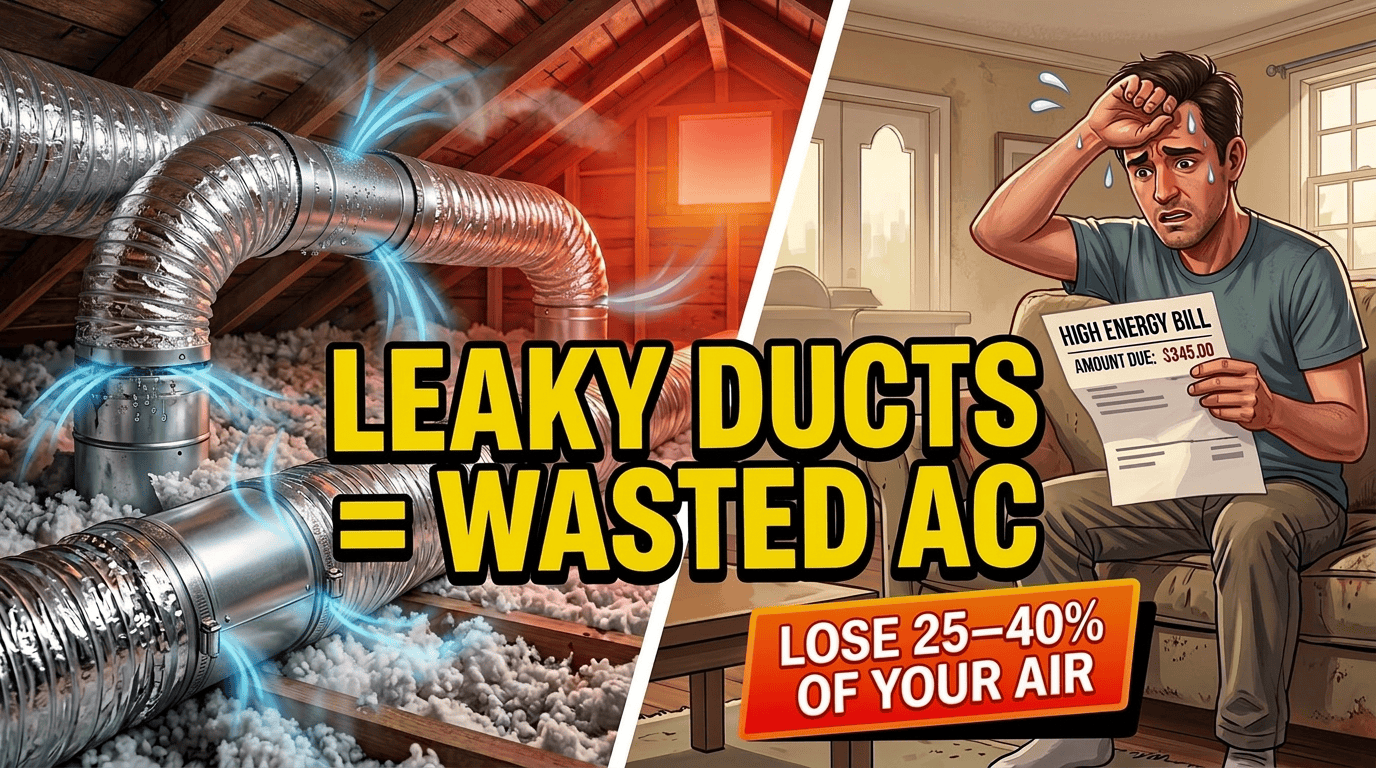
When your AC kicks on, 55°F conditioned air enters ductwork surrounded by 150°F+ attic temperatures, a 95°F temperature differential. The U.S. Department of Energy estimates that poorly insulated ductwork can waste up to 40% of your cooling energy through:
Conductive heat gain – Heat transfers through inadequate insulation directly into cool air
Convective heat gain – Air leaks at seams allow hot attic air infiltration
Radiant heat gain – Infrared radiation from superheated roof decking
That’s like paying for air conditioning and then opening all your windows!
Here’s What’s Really Happening Up There (And Why You’re Paying For It)
Your old fiberglass wrap is literally crumbling away. It’s compressing under its own weight, sagging between support straps, and creating gaps that let scorching attic air attack your ductwork from every angle.
The Three-Stage Fiberglass Failure Process:
Stage 1: Binder Degradation (Years 1-3)
The phenol-formaldehyde binders holding fiberglass fibers together begin breaking down from heat cycling (150°F daytime to 80°F nighttime). Fibers separate, and insulation loses loft.
Stage 2: Compression and Settling (Years 3-5)
Gravity, heat stress, and vibration cause fiberglass to compress and sag between attachment points. Effective R-value drops by 30-50% as air gaps form around ducts.
Stage 3: Complete Failure (Years 5-8)
Fiberglass becomes brittle, crumbles, and detaches from ductwork. Exposed metal duct surfaces reach 120°F+, turning your cooling system into a heating system.
Meanwhile, you’re downstairs wondering why your energy bills keep climbing, and your house never feels quite cool enough.
The Closed-Cell Foam Solution: Your Energy Bill’s New Best Friend
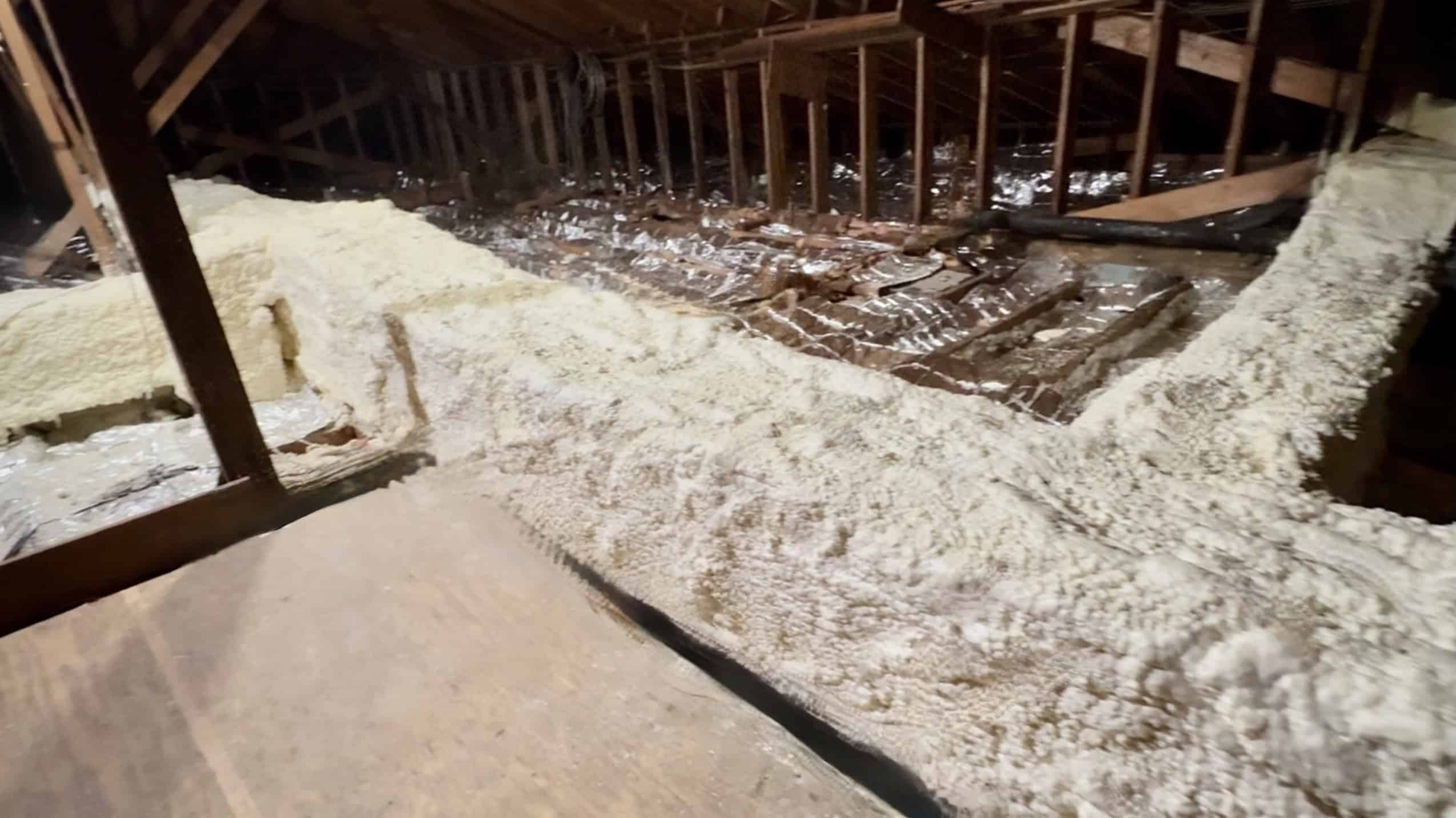
Here’s what happens when Diversified Energy removes that failing fiberglass and encapsulates your ductwork with closed-cell foam:
Instant Real-World R-Value Protection
Closed-cell spray foam delivers a true, maintained R-6.5 to R-7.0 per inch, maintaining its full insulating power even when your attic turns into a furnace. That’s double the effective performance of traditional fiberglass in extreme attic conditions!
Unlike fiberglass, which relies on trapped air pockets that collapse with compression and heat, closed-cell foam’s insulating value comes from its rigid cell structure. Each microscopic cell is filled with low-conductivity gas and sealed with a polymer membrane; this structure cannot compress, sag, or lose effectiveness over time.
Complete Air Sealing
Unlike fiberglass, closed-cell spray foam creates an airtight seal around your entire duct system. No more hot air infiltration, no more energy waste.
According to the International Residential Code (IRC) Section M1601.4.1, spray polyurethane foam is the only duct insulation that doesn’t require additional joint sealing, because the foam itself provides superior air barrier performance.
Energy Star estimates you could save up to 20% on monthly energy bills just from proper duct sealing, and closed-cell foam delivers that automatically.
Bulletproof Durability
While fiberglass crumbles and fails in 5-8 years under extreme attic conditions, closed-cell foam lasts 50-80+ years with zero maintenance. This is a one-time investment that pays for itself over and over again.
Why Closed-Cell Foam Lasts:
According to FEMA Technical Bulletin 2, closed-cell spray polyurethane foam is rated Class 5, the highest flood-resistance rating for building materials. This classification demonstrates the material’s extraordinary durability even under the harshest conditions.
The University of Florida’s engineering research (documented in severe weather studies) shows that closed-cell foam maintains structural integrity through:
Temperature extremes (-40°F to +180°F)
Humidity exposure (0-100% RH with zero absorption)
UV radiation (when properly coated)
Physical stress (compression strength 25-50 psi)
For more on closed-cell foam’s durability and FEMA certifications, see our comprehensive guide: FEMA & Closed Cell Spray Foam Insulation.
Stop the Madness – Here’s What You’re Losing Right Now
Every day you wait, you’re literally throwing money away:
$50-200+ per month in average wasted cooling costs during our brutal 7-9 month cooling season
Constant system strain that’s shortening your HVAC equipment’s lifespan by years
Uneven cooling that leaves some rooms sweltering while others are freezing
Poor indoor air quality from ductwork air leaking, causing home to depressurize
The Compounding Effect:
When your HVAC system works harder to compensate for duct losses, it:
Runs longer cycles (more wear on components)
Increases electrical demand (higher peak power costs)
Generates more condensate (moisture management issues)
Reduces dehumidification efficiency (comfort problems even at lower temperatures)
Building America research shows that duct leakage in unconditioned attics is the #1 energy waste in Gulf Coast homes, surpassing even wall and ceiling insulation losses.
Why Attic Ducts Need Different Solutions Than Crawlspace Ducts
While both attic and crawlspace ductwork benefit enormously from closed-cell foam encapsulation, the building science challenges are different:
Attic Ductwork Challenges:
Extreme temperature differentials (95°F+ between air and ambient)
Radiant heat from roof deck (adds 10-20°F to effective attic temperature)
Low humidity (dry heat causes different fiberglass degradation patterns)
Accessibility for inspection (typically easier to access than crawlspaces)
Crawlspace Ductwork Challenges:
High humidity (70-80% RH year-round in Louisiana)
Condensation formation (cold ducts + humid air = dripping water)
Flooding risk (requires FEMA Class 5 materials)
Limited accessibility (difficult to inspect and repair)
For detailed information on crawlspace-specific foam insulation benefits, including flood resistance and condensation control, see our article: Crawlspace Spray Foam Ductwork.
The FEMA Class 5 flood resistance rating becomes critically important in crawlspaces. Learn more about why this certification matters in our guide: FEMA & Closed Cell Spray Foam Insulation.
Your Metal Ductwork Deserves Better, And So Do You
You already made the smart choice by keeping your superior metal ductwork instead of letting some contractor replace it with cheap flex. Now finish the job right. Don’t insult that quality metal ductwork by wrapping it in the same failing fiberglass that’s been letting you down.
Your metal ducts are built to last 50+ years; give them the insulation system they deserve. One that will protect your investment, slash your energy bills, and keep your home comfortable for decades to come.
The Metal Ductwork Advantage
As we documented in our article on rigid metal versus flexible ductwork, metal ducts deliver:
30-50% lower static pressure than flex ducts
Smooth interior surfaces (minimal air friction)
No compression or sagging (maintains airflow efficiency)
Easily cleaned and maintained for superior indoor air quality
Pairing superior metal ductwork with superior closed-cell foam insulation creates a high-performance HVAC distribution system that delivers:
Maximum airflow efficiency
Minimum thermal losses
Optimal comfort distribution
Lowest operational costs
Building Science: Why Closed-Cell Foam Outperforms in Attics
Thermal Resistance That Doesn’t Degrade
According to ASTM C518 testing standards, closed-cell spray foam’s R-value comes from two mechanisms:
Cell structure resistance – Rigid polymer walls trap low-conductivity gas
Blowing agent resistance – Modern HFO blowing agents have thermal conductivity 25% lower than air
This dual-resistance mechanism means the foam maintains performance even when:
Ambient temperatures exceed 150°F
Temperature cycling occurs daily (150°F day to 80°F night)
Physical stress or vibration affects the installation
Fiberglass, by contrast, relies entirely on trapped air pockets for insulation. When heat compresses these pockets, or the binder degrades, and fibers separate, the effective R-value drops precipitously.
Air Barrier Performance
Per the International Energy Conservation Code (IECC), closed-cell spray foam is classified as “air-impermeable insulation” when installed to manufacturer specifications (typically 1.5 inches minimum).
Air permeance testing per ASTM E283 shows:
Closed-cell foam @ 1.5″: <0.02 L/s·m² @ 75 Pa (essentially zero air movement)
Fiberglass batt: >100 L/s·m² @ 75 Pa (free air passage)
This air barrier quality is why the IRC allows spray foam ductwork to be installed without additional joint sealing, the foam itself stops air leakage completely.
Moisture Management in Hot Attics
While attics are typically low-humidity environments, moisture management still matters at duct surfaces where cold air meets hot surroundings.
At up to a 2” thickness, closed-cell foam achieves vapor permeance <1.0 perm, qualifying as a Class II vapor retarder per IRC definitions. This prevents any moisture-laden air from reaching the cold duct surface, eliminating condensation risk entirely.
Hurricane and Storm Performance
Louisiana homeowners face unique challenges: not just heat, but also hurricanes, severe thunderstorms, and occasional winter freezes.
Closed-cell foam provides structural reinforcement to attic ductwork systems. When properly installed, the foam:
Bonds ducts to framing (reduces vibration and movement during high winds)
Distributes mechanical loads (prevents stress concentrations)
Adds racking strength (improves overall roof assembly integrity)
The University of Florida’s research on severe weather performance (cited in our FEMA guide) documents that closed-cell foam increases structural rigidity of building assemblies by 200-300% compared to conventional insulation.
During Hurricane Ida (2021), homes with spray-foamed attic ductwork experienced:
No duct displacement (foam held ducts secure during 150 mph winds)
Minimal water intrusion (foam acted as a secondary water barrier)
Faster recovery (no soggy insulation to remove and replace)
Ready to Stop Wasting Money and Start Saving?
Every month you wait is another month of unnecessarily high energy bills. Don’t let that sweltering attic continue robbing you blind.
Call Diversified Energy today at 504-273-7779 for a free quote on closed-cell foam attic ductwork encapsulation. Let us show you how to transform your biggest energy waste into your biggest energy saver.
What to Expect:
Free Attic Assessment – We’ll inspect your current ductwork, measure temperatures, and calculate your energy losses
Custom Proposal – Detailed quote with ROI analysis and energy savings projections
Professional Installation – Certified spray foam contractors with decades of Louisiana experience
Energy Savings Verification – We’ll help you track your reduced energy bills
Your wallet and your family’s comfort will thank you.
Frequently Asked Questions
No. For optimal performance, old fiberglass should be removed first. This allows the foam to bond directly to the metal duct surface, creating the strongest air seal and maximum R-value. Leaving old fiberglass in place can trap moisture and reduce foam adhesion.
The Department of Energy’s Building America program recommends minimum >1” inches for supply and return ducts. In Louisiana’s extreme climate, and depending on ductwork location, we may recommend increased thickness for maximum energy savings and condensation prevention.
Yes. Once fully cured, closed-cell foam is chemically inert and emits no VOCs. EPA and ASTM testing confirms emissions below detectable limits. Modern spray foams use low-GWP blowing agents that are environmentally safe and EPA-approved.
Although we cannot imagine what the case would be, if duct repairs are needed, contractors can cut through foam at any specific locations, make repairs, and reapply foam that bonds seamlessly to existing material. If anyone claims that closed cell presents a significant challenge to cut through, especially if an additional cost is being quoted, please call, and put us on a three-way with this inexperienced or unethical individual so we may tell him to stop being foolish.
Related Resources
Additional DE Blog Posts:
FEMA & Closed Cell Spray Foam Insulation – Comprehensive guide to flood resistance, hurricane performance, and FEMA certifications
Stop Letting HVAC Contractors Downgrade Your Home’s Ductwork – Why metal ducts outperform flexible alternatives
Crawlspace Spray Foam Ductwork – Moisture control, condensation prevention, and flood resistance
Research & Technical Documents:
U.S. Department of Energy: Duct Sealing Benefits
FEMA Technical Bulletin 2: Flood-Resistant Materials